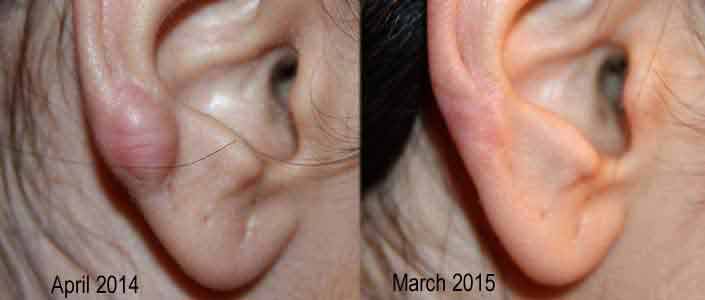
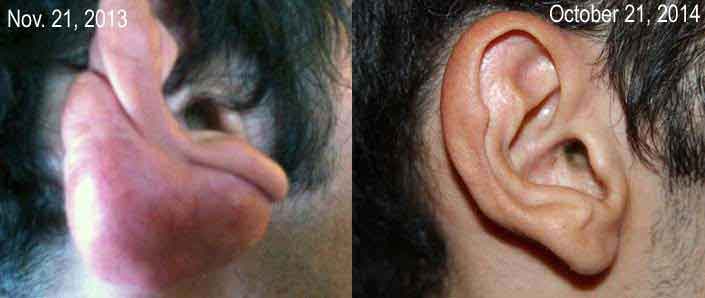
Signifcant improvement was achieved with medical treatment.
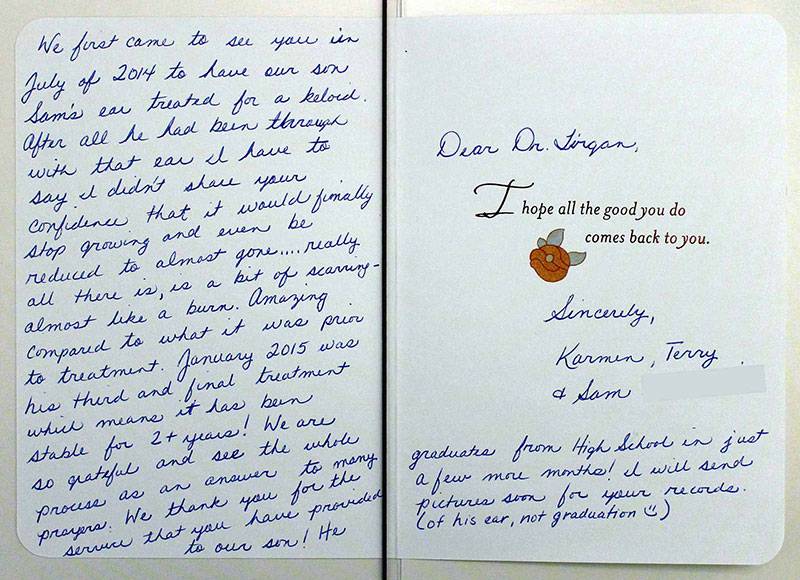
Letter from a patient's family to Dr. Tirgan
Dear Dr. Tirgan,
We first came to see you in July of 2014 to have our son Sam’s ear treated for a keloid. After all, he had been through with that ear I have to say I didn’t share your confidence that it would finally stop growing and even be reduced to almost gone….. really all there is is a bit of scarring – almost like a burn. Amazing compared to what it was prior to treatment. January 2015 was his third and final treatment which means it has been stable for 2+ years! We are so grateful and see the whole process as an answer to many prayers. We thank you for the service that you have provided to our son! He graduates from High School in just a few more months! I will send pictures soon for your records. (of his ear, not graduation)
Sincerely,
Karmen, Terry & Sam
(April 2017)
Specialized Treatment for Keloids Only
New York is home to hundreds of dermatologists and plastic surgeons who treat keloids among other conditions. However, Dr. Tirgan is the only physician in North America whose medical practice and research are exclusively dedicated to the treatment of keloid patients. Over the past several years, Dr. Tirgan has treated more than 3,000 keloid patients, many of whom have traveled from distant locations to seek his specialized care in New York.
Our Reviews
What is Keloid Disorder?
Keloid disorder is a chronic skin condition that can significantly impact patients' quality of life. It may manifest as a single small lesion or as multiple lesions across different parts of the body. In some cases, keloid lesions can grow extensively, forming large skin tumors.
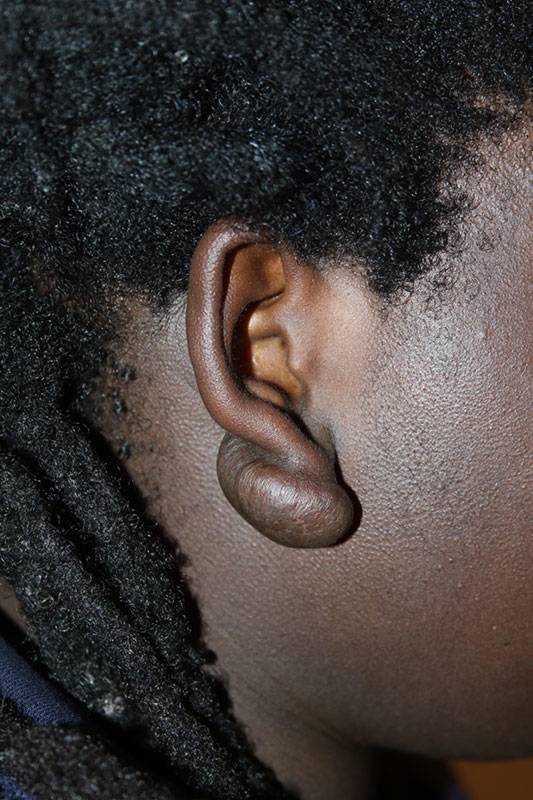
Keloid disorder has a genetic component and often runs in families. It is most commonly seen in individuals of African, African American, and Asian descent, though cases have been reported across almost all ethnic backgrounds. For those predisposed to the condition, keloids develop only after skin injury, which can result from various causes such as ear piercing, acne, surgery, or chickenpox.
Why Specialized
Treatment Only?
When a healthy person experiences skin injury, such as a surgical incision or piercing, the skin undergoes a predictable healing process. The tissue fuses back together, forming scar tissue, and through a complex negative feedback system, the body knows when to stop the healing once it’s complete.
In keloid disorder, however, this feedback mechanism malfunctions. Instead of halting the healing process, the body continues an excessive and prolonged wound-healing response, as if the "brakes" on healing are not functioning properly. This leads to the uncontrolled growth of scar tissue, resulting in keloid formation.
If a keloid is surgically removed, the same abnormal healing mechanisms are triggered, often leading to the development of a new, larger keloid. In contrast, cryotherapy does not involve cutting the skin, so the underlying tissue remains intact. As a result, the healing response does not stimulate further keloid formation, making it a preferred treatment option.
Why Seek Treatment from Dr. Tirgan?
Dr. Tirgan is the only physician in North America whose practice is exclusively dedicated to the treatment of keloid patients. With over 3,000 keloid cases treated, many patients continue to travel long distances to seek his specialized care.
As an international leader in keloid research and cryotherapy, Dr. Tirgan has extensively published his clinical findings and is a frequent speaker at major dermatology and plastic surgery conferences worldwide. His expertise in keloid treatment is recognized globally.
Dr. Tirgan is redefining standard treatment approaches for keloids, introducing therapies that prioritize patient safety. His methods not only deliver excellent results but also avoid the risks of exacerbating the condition, a concern with many conventional treatments such as surgery and radiation therapy. If you have keloids that have worsened despite previous treatments or surgeries, or if your doctor has run out of effective options, there is still hope. Dr. Tirgan has successfully helped numerous keloid sufferers like you, and his patient-centered approach can provide the relief you’ve been searching for.
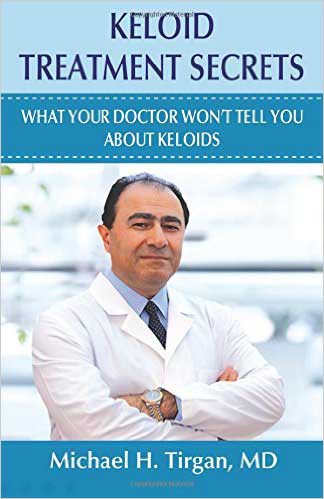
Keloid Treatment Secrets
Keloid Treatment Secrets is an easy-to-read book for anyone who is dealing with keloid disorder. In this book, Dr. Michael H. Tirgan discusses various aspects of this skin condition and provides the reader with an in-depth understanding of this condition. The reader will learn about simple treatment choices, how keloids should be treated, and most importantly about the treatments that are harmful and should be avoided.
If you are diagnosed with keloid or have been dealing with it for a long time, this book may help you to better understand your condition. It also arms you with the knowledge you need to make correct treatment choices.
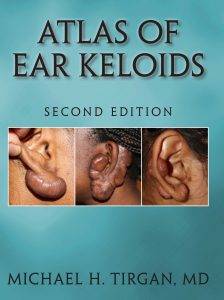
Atlas of Ear Keloids
Keloids are an important medical problem that is often under-appreciated by the medical community. Dr. Michael Tirgan has spent many years evaluating and treating patients with keloids in different regions of the body. The Atlas of Ear Keloids presents new insights into the natural history of keloids and provides a perspective that many of the standard surgical approaches may actually lead to the progression of these tumors on the ear. He presents good examples of an alternative treatment with cryotherapy that has convincingly eliminated some of the most troublesome keloids on the ear. This book will provide valuable information to patients with keloids on the ear and to medical professionals that treat these lesions. Atlas of Ear Keloids is available on Amazon.com.
James G. Krueger, M.D., Ph.D.
Laboratory of Investigative Dermatology
The Rockefeller University
New York
Clinical Practice Guidelines for Treatment of Keloids
This guideline publication compiles recommendations for treating patients with common clinical presentations of keloid disorder. As you will observe throughout this volume, keloid patients do not present uniformly; each individual has unique challenges. Therefore, treatment for each keloid lesion should be tailored to the specific needs of the patient.
The instinctive response to a newly developed keloid in a young person may be to surgically remove the lesion. However, as documented in this guideline, rushing into surgery can often exacerbate the keloid condition. Keloid disorder is progressive and multifocal, meaning that a premature surgical intervention can lead to worsening symptoms. A deeper understanding of the fundamental aspects of this chronic genetic condition will enable us to make more effective treatment choices.
All the Guidelines documents are available on the website of Keloid Research Foundation .
BEFORE AND AFTER TREATMENT

Ear Keloid - Treatment Results with Cryotherapy

Otoplasty Keloid - Treatment Results with Cryotherapy